Smoking-Induced "Pseudo-Rhinitis" vs. True Allergic Rhinitis: How to Tell the Difference
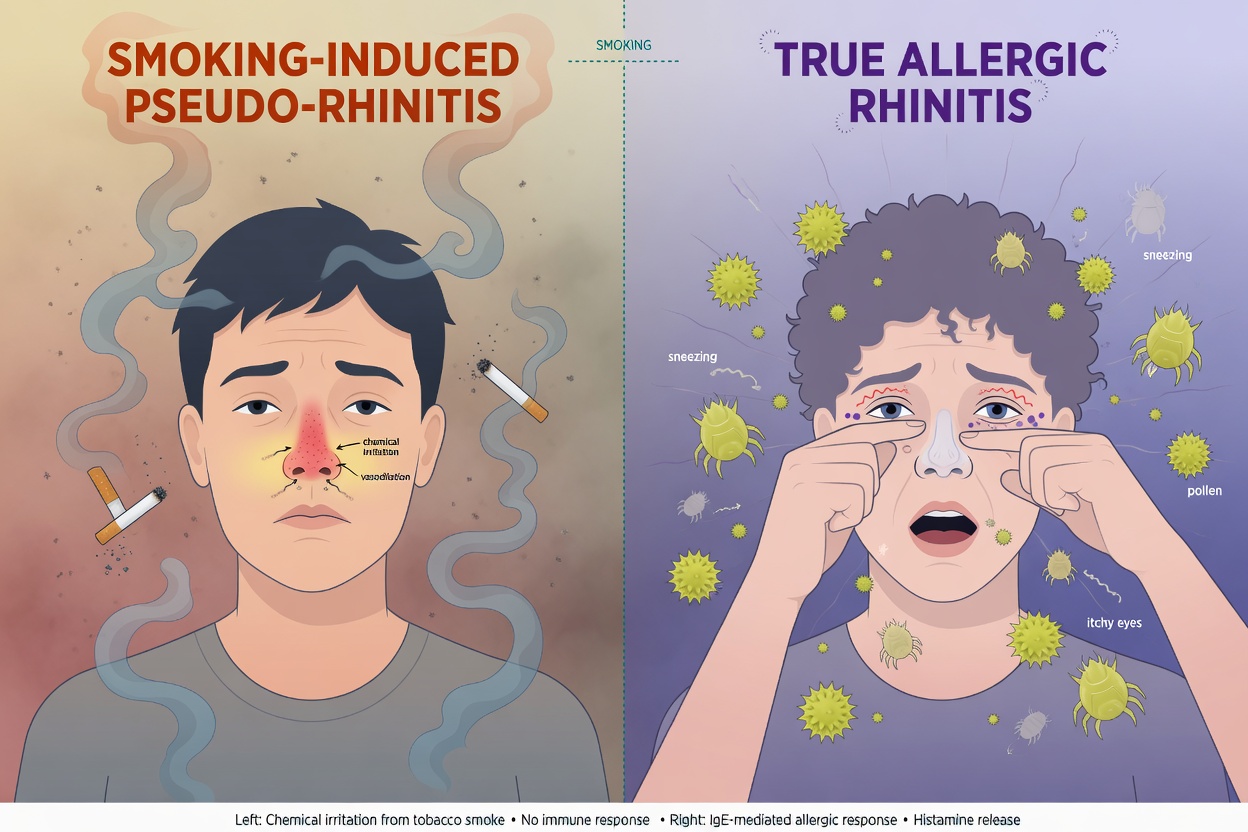
Many people light a cigarette while rubbing their nose: sneezing repeatedly, clear runny nose, alternating nasal congestion, and occasionally nasal itching or a throat that constantly needs clearing. Family members might say "you're having allergies," while the smoker themselves tends to attribute it to "smoking." Both judgments **could be right, or neither could be complete** — the pseudo-rhinitis-like symptoms caused by smoke irritation and true allergic rhinitis share highly overlapping symptoms, yet differ critically in mechanism, triggers, testing pathways, and treatment response. Knowing the direction helps you decide: try reducing smoking first, or see an ENT/allergy clinic promptly.
**Disclaimer:** This article is for health education purposes and does not constitute individual medical advice. "Pseudo-rhinitis" here is a popular-science term for easier understanding and does not equate to any single, fixed clinical diagnosis. For specific diagnosis and medication, please consult a licensed physician and undergo necessary examinations. Those with asthma, chronic sinusitis, cardiovascular disease, mental illness, or who are pregnant or preparing for pregnancy should prioritize specialist evaluation.
I. Clarifying Concepts: What is "Pseudo" and What is "True Allergy"
1. "Pseudo-Rhinitis" in a Popular-Science Context
The **smoking-related "pseudo-rhinitis"** discussed in this article mainly refers to:
Clinically, these manifestations are often classified under or overlap with:
It is called "pseudo" not because the symptoms are fake, but to emphasize: **it looks like allergic rhinitis but may not actually be an allergy to a specific allergen**.
2. True Allergic Rhinitis
**Allergic rhinitis** typically refers to:
Based on attack patterns, common types include:
3. The Most Easily Overlooked Fact: They Can Coexist
A smoker can have:
1. **Only irritant/non-allergic predominant symptoms**;
2. **Be an allergic rhinitis patient themselves, with smoke being an aggravating factor**;
3. **Both allergic and smoke irritation pathways activated simultaneously**.
Therefore, the goal of differentiation is not to "conclusively label" yourself at home, but to answer two practical questions:
4. Other "Actors" to Keep in Mind
Rhinitis-like symptoms are not just a "pseudo vs. allergic" binary choice. During a consultation, doctors may also investigate or consider:
| Direction | Brief Clues |
|---|---|
| Infectious rhinosinusitis | Purulent discharge, facial pain/pressure, decreased smell, fever, prolonged course |
| Drug-induced rhinitis | Long-term, frequent use of decongestant nasal drops/sprays causing "more congestion the more you spray" |
| Anatomical factors | Deviated nasal septum, inferior turbinate hypertrophy, often presenting as fixed unilateral congestion |
| Occupational or home irritants | Paint, dust, cleaning agents, cooking fumes, sealed air-conditioned environments |
| Other systemic associations | Thyroid dysfunction, medication side effects, pregnancy-related nasal congestion (requires individual evaluation) |
The focus below remains on: **smoking-related irritant manifestations vs. allergic rhinitis**.
II. Symptom Features: A Comparison Table for Self-Assessment
The table below provides **directional comparison** — the more items in a column match you, the more worth exploring that direction; **do not conclude based on one or two symptoms alone**.
| Observation Dimension | More Like Smoking-Related "Pseudo/Irritant" Manifestations | More Like True Allergic Rhinitis | Be Alert for "Other Problems" |
|---|---|---|---|
| Temporal relationship with smoke | Worsens noticeably during smoking or within minutes to hours after; triggered upon entering smoking area | More synchronized with specific allergen exposure; smoke may aggravate but not necessarily the only trigger | More related to posture, unilateral structural issues, infection course |
| Nasal itching | Mild itching/burning sensation, sometimes more like "irritation pain, dry itch" | **Nasal itching often prominent**, may accompany eye, palate, and ear itching | Severe unilateral pain, numbness requires medical attention |
| Sneezing | May occur, mostly after smoke, cold air, irritant odors | **Paroxysmal continuous sneezing** more typical, also common in morning | Consider infection when accompanied by high fever, systemic toxicity symptoms |
| Nasal discharge | Clear or mucoid; smokers often have thick discharge, frequent need to blow, post-nasal drip | **Clear watery discharge during attack episodes** is very common | Yellow-green purulent discharge, foul odor, blood-stained requires attention |
| Nasal congestion pattern | Related to smoking amount, smoky environment, mouth breathing, nighttime lying; may be worse in morning | Can be seasonal or worsen after allergen exposure; bilateral alternation also common | **Fixed unilateral persistent congestion** be alert for structural or mass lesions |
| Eye symptoms | May have smoke-induced dry eyes, irritation | **Eye itching, tearing, conjunctival congestion** more supportive of allergic | |
| Smell | Long-term smokers often have dull or fluctuating smell | May decrease when congestion is severe; sudden complete loss requires investigation of other causes | Sudden complete loss + neurological symptoms requires emergency evaluation |
| Seasonality | Can occur year-round, more noticeable during air-conditioning season, dry season, after smoking gatherings | Can be highly seasonal (pollen) or perennial (dust mites) | Recurrent "cold-like" prolonged course in winter suggests sinusitis |
| Skin/systemic allergy history | Not necessarily present | Often have eczema, asthma, food/drug allergies personal or family history | — |
| After quitting / away from smoke | **Irritant symptoms may partially improve within weeks to months** | Symptoms can still be significant if allergens not controlled; but overall may be reduced after removing smoke | Anatomical/chronic infections won't resolve by quitting alone |
| Response to antihistamines | Limited or inconsistent effect for some | Many experience improvement in itching, sneezing, runny nose (varies greatly by individual) | Complete ineffectiveness cannot rule out nasal disease; requires specialist judgment |
How to Read This Table (Practical Rules)
III. Triggers: More Actionable Than "Am I Allergic?"
1. Non-Specific Irritants (Common Triggers in Smoking-Related "Pseudo" Pathway)
The characteristic of these triggers: **they don't necessarily require an allergy to a specific protein** — they directly irritate nasal mucosal sensory nerves and vascular responses.
2. Allergen-Related Triggers (Allergic Pathway)
Characteristics: **in the same environment, "some people are fine, some always have attacks"**, and can correspond with skin tests or serum specific IgE (though false positives/negatives exist, requiring physician interpretation).
3. Seven-Day "Exposure-Symptom-Removal" Diary (Strongly Recommended)
Use your phone's notes app, record 4 columns daily:
| Time | Exposure (smoke/dust/pet/pollen/AC) | Symptoms 0–10 | Action taken (rinse/leave/medication) |
|---|---|---|---|
| E.g., after lunch | 10 min in office smoking area | Congestion 7, sneezing 5 | Dropped to 3 after 30 min away |
Keep for **7–14 days**; you'll see more clearly:
Bring this diary to your appointment — it's ten times more effective than saying "my nose is bad."
IV. Examination Methods: Which Are Useful, Which Not to Worry About
1. Medical History and Specialist Examination (First Stop is Usually ENT)
The doctor will typically focus on:
**Examination alone cannot 100% distinguish allergic from non-allergic**, but can identify infection, structural issues, severe mucosal lesions, etc. that "shouldn't be delayed."
2. Allergen-Related Testing
Common tests include:
**Significance:**
**Limitations (must know):**
3. Other Tests (As Needed, Don't Self-Interpret)
4. Pre-Consultation Preparation Checklist (Copy and Use)
V. Disease Course and Treatment Response: Another Clue for Differentiation
1. Timeline After Reducing/Quitting Smoking (General Principles)
After reducing smoke-related irritation, some people may experience:
If after **strictly avoiding smoke for 1–3 months**, irritant complaints remain nearly unchanged, and nasal itching, sneezing, and eye itching are prominent, you should more actively investigate allergies or other nasal diseases rather than repeatedly attributing it to "smoking damage that hasn't healed."
Conversely: when allergens are not controlled, **symptoms reduced after quitting but not disappearing is a common phenomenon** — it doesn't mean quitting is "useless," but that there's a second line to manage.
2. "Response Tendency" of Different Interventions
| Intervention | For Irritant/Pseudo Manifestations | For Allergic Rhinitis |
|---|---|---|
| Avoiding tobacco smoke | Often one of the core effective measures | Removes aggravating factor, helps overall control |
| Saline rinse/humidification | Most people improve stickiness and irritation | Also recommended as basic care |
| Oral/nasal antihistamines | Limited benefit for some | Often helps with itching, sneezing, discharge |
| Nasal corticosteroids | May benefit congestion and inflammation load | Often an important approach for controlling congestion and inflammation (per doctor's advice) |
| Relying solely on decongestant sprays | Short-term relief, long-term leads to drug-induced rhinitis | Also not recommended for long-term reliance |
**Any specific drug, course, or suitability can only be determined by a doctor.** This article does not provide prescribable prescriptions.
3. A Dangerous "False Improvement"
Some smokers use strong decongestant sprays to get temporary relief, mistakenly thinking "my nose problem is solved," and continue exposure to smoke — this is **symptom masking**, not disease resolution. If you've reached the point where "without spraying I'm completely blocked, only spraying makes me functional," seek specialist care for drug-induced rhinitis risk as soon as possible.
VI. Overlap Scenario: Allergic Constitution + Smoking
The typical story often goes:
I already felt bad during pollen season or seasonal changes; after smoking, congestion goes up another level; after quitting, it gets better, but once I sweep the floor or pet a cat, it comes back.
The management principle for overlap can be summed up in three sentences:
1. **Smoke is a controllable exposure you can reduce immediately** — prioritize this.
2. **Allergens require environmental control + standardized anti-inflammatory/anti-allergy strategies** — don't just tough it out.
3. **Running both tracks in parallel is more useful than arguing about "whose fault it is."**
For nasal-sensitive smokers, quitting is not just "health correct" — it's infrastructure for reducing nasal mucosal burden. But if tests and history strongly support allergies, **quitting cannot replace allergen management and specialist treatment.**
VII. Red Flag Symptoms: Stop Treating as "Rhinitis"
If any of the following occurs, **see an ENT specialist promptly (or emergency if necessary)** rather than continuing to self-classify with comparison tables:
The priority of these situations far exceeds "differentiating pseudo from allergic."
VIII. What You Can Do Now: Two Tracks
Track A: 1–2 Week Self-Observation Package (Mild Symptoms, No Red Flags)
1. **Maximally reduce active and passive smoke exposure** (including in car and third-hand smoke areas at home).
2. **Keep an exposure-symptom diary**.
3. **Basic nasal care**: saline rinse or spray, moderate indoor humidification, avoid dry hot air blowing directly on face (method per product instructions and doctor's advice).
4. **Stop or seek evaluation ASAP** for long-term decongestant spray use.
5. **Sleep and mouth breathing**: side sleeping, nasal moistening, reduce mouth breathing that worsens dryness.
If after 1–2 weeks symptoms still significantly affect sleep or work, or diary shows clear allergen patterns, proceed to Track B.
Track B: Indications for Scheduling an ENT Appointment
Relationship with Quitting Smoking (One-Sentence Positioning)
**Quitting is an upstream infrastructure for improving the nasal microenvironment; specialist diagnosis is the navigation system for identifying allergies, infections, structural and drug-induced factors.** The two work together to prevent spinning in the fog of "pseudo vs. allergic."
IX. Common Misconceptions Quick Correction
| Misconception | More Reasonable Understanding |
|---|---|
| "Sneezing means allergy" | Smoke and cold air irritation can also trigger continuous sneezing |
| "Antihistamines don't work, so it's not rhinitis" | May be primarily non-allergic, or medication type/method mismatched, or accompanied by sinus/structural issues |
| "Quitting will immediately fix my nose" | Can reduce irritant load, but allergies, anatomy, chronic inflammation won't zero out overnight |
| "E-cigarettes/heat-not-burn don't harm the nose" | Aerosols and flavorings can still cause irritation; individual variation large, cannot be considered "rhinitis amnesty" |
| "Decongestant sprays are safe for daily use" | Short-term emergency use debatable; long-term easily leads to drug-induced rhinitis |
| "I tested negative for allergies, so I don't need to care about my nose" | Non-allergic rhinitis and irritant damage also require management |
| "It's all allergies, quitting doesn't matter" | Smoke is a clear aggravating factor; not reducing smoke means adding resistance to treatment |
| "I can diagnose myself from an online allergy panel" | Results must be combined with history and interpreted by a doctor |
X. Summary: Decision Card
**More indicative of smoking-related "pseudo/irritant":**
**More indicative of true allergic rhinitis:**
**Must seek medical attention:**
**Regardless of type:**
XI. Reference Directions (For Extended Reading)
Readers who wish to further systematically explore may search for the following types of materials (based on authoritative institutions and textbook consensus, pay attention to version updates):
Conclusion
Smoking-related "pseudo-rhinitis-like manifestations" and true allergic rhinitis share many superficial symptoms but differ in **triggers, immune mechanisms, testing pathways, and long-term management**; more commonly, they **coexist** rather than being black and white. For smokers, the most valuable action isn't arguing over a diagnostic label at home, but:
1. Using symptom features and exposure diary to make **directional assessment**;
2. Using the red flag checklist to decide **whether to seek immediate medical attention**;
3. Treating **smoking reduction/cessation** as foundational infrastructure for nasal relief, while accepting ENT and allergy evaluation when needed.
Your nose's protest is often one of the earliest readable signals your body sends. Read it, then decide your next step — that's far more reliable than lighting another cigarette to cover the signal.
Note: The above comparison is for directional reference only and does not replace professional diagnosis.